




Are you someone who lives and breathes jazz and can’t imagine doing anything else in college? If you’re wanting to major in jazz, here are 8 top considerations from jazz faculty, students, and recent graduates for anyone thinking about majoring in jazz or already on their way.
by Barbra Weidlein –
1. Why Go to Music School to Study Jazz If You’re Already Performing?
While some young musicians at the top of their game will make a name for themselves without ever going to music school, careers in music are so highly competitive that musicians need all the knowledge, support, and connections they can get.
According to Alan Pasqua, professor of Jazz Studies at University of Southern California Thornton School of Music, “Music school increases your chances of being a better musician. It’s a structured environment with other high level, motivated students, that offers networking opportunities and knowledge. It’s a way to become more fluent in jazz.”
Pasqua goes on to say that young musicians who think they can learn what they need to learn, by simply studying with a private teacher, will miss out on everything that happens after the lesson is over. “In music school, the learning is ongoing. It’s so easy to find fellow students to play with, to continue the learning. There are also opportunities to meet so many others in fields that will be important to you in your life.”
2. Choose a Direction
First and foremost: do you want to focus on performance? Or on the history of jazz? Do you want to teach? Or are you leaning toward a career in music industry, with jazz as your focus? Schools differ in their strengths, so a good starting place is to clarify what you think you want to do when you graduate. Richard Dunscomb, chair of the Music Department at Columbia College Chicago, recommends that you research and then ask each school you’re interested in to specify what type of jazz education you will get there.
For performance-driven students, Harry McKenzie, who got his Bachelor of Music degree in Jazz Studies at USC Thornton School of Music in 2012, suggests looking closely at schools “in cities that have thriving jazz scenes, so you can start establishing yourself as a professional player while you’re in school.”
3. Become a Good Improviser
Music schools typically expect jazz students to know how to improvise by the time they audition. But how do you get there?
According to John Murphy, chair of Jazz Studies at University of North Texas College of Music, “Learning how to improvise, and to play jazz in general, is a lifelong pursuit. The best thing you can do is to listen with your full attention to important artists on your instrument (including voice) and on other instruments. Much of the listening we do these days is distracted. Anyone who wants to learn how to play jazz needs to listen with full attention, with no distractions, repeatedly. There’s no better way to learn what you want your tone to sound like, how to feel the time, how to play a solo that tells a story.”
4. Get the Most Out of Your Program
Take responsibility for finding out what you need to learn if you want a career in music. Don’t expect music schools to lay it all out for you. Talk with professors who are also performers or who have backgrounds in music industry, music education, or any area of music you’re interested in. Find out what they wish they’d learned when they were in music school. And, as professionals, what skills/tools they can’t do without.
“You get out what you put in,” says John Gunther, composer and multi-reed instrumentalist, and associate professor of Jazz Studies at CU Boulder College of Music. “Be active and pro-active. Study hard and practice a lot but also look for or create opportunities to play with your peers. Get familiar with other instruments (everyone should play drums and piano!). Be familiar with things happening outside your immediate environment (theatre, dance, classical concerts, etc.). You also have to take care of yourself….sleep, good food, exercise.”
Drew Zaremba, senior jazz studies major at University of North Texas College of Music, spends as much time as possible with faculty to learn as much as he can, and then practices everything he learns. “Your colleagues are an equally important source of inspiration and encouragement,” he adds, “so finding good dedicated musicians as friends is essential!”
Addision Frei, University of North Texas College of Music junior and an award-winning pianist, agrees. “One of the most important aspects of studying jazz in college is connecting to your peers and establishing strong music relationships. Playing with others outside school is the most helpful way to harness ideas obtained in class and to develop an artistic identity. Supporting peers at local performances is also crucial to becoming a part of a musical community.”
5. Find the Right Teacher
The importance of finding the right teacher can’t be underestimated. John Davis, director of Jazz Studies at CU Boulder College of Music, recommends: “Find a teacher who plays how you would like to play, but who also has been recommended as a good teacher. Unless the teacher/performer can relate ways to practice and play effectively, all you may end up with is a great player who sounds good but who can’t help you sound good. You want to find a teacher who can effectively provide approaches and ideas that will help you grow.”
Alan Pasqua offers these suggestions:
- Find a teacher who can be a mentor.
- Find a teacher whose performance you can emulate.
- Find someone with whom you can work well, and with whom you have good relationship dynamics (i.e., chemistry is important!).
- Find out how much time the teachers you want to study with are really at the schools you’re looking at applying to. Many tour, so you’ll want to know whether they’ll actually be teaching your classes and how available they’ll be for your questions and concerns outside of class time.
- Connect with anyone you might want to study with, before you start applying to schools. They should be willing to email with you and hopefully give you a lesson, as a prospective student at their school.
6. Know What’s Required to Be Successful
“You must develop a repertoire of jazz standard tunes,” says John Davis, a trumpet player who has taught everything from jazz history to big band and vocal jazz. “These are tunes you have memorized, know the chord changes, and can improvise over. All jazz musicians are expected to have a large base of jazz tunes in their ‘arsenal’ to be competitive and functional in the industry.”
Learning to network is vital. According to Alan Pasqua, whose background includes playing electric keyboard for TV shows and performing with legendary musicians including Bob Dylan, Santana, Ray Charles, Elton John, and Queen Latifa, “The networks you develop in college are the most important for meeting friends, fellow students, and for learning about other areas. Your friends will become your co-workers and the people who hire you.”
Los Angeles guitarist, Erik Miron, a 2009 graduate of USC Thornton School of Music, concurs. “The importance of networking and forming groups with my peers –– this was critical, and in my opinion much more important than coursework.”
Drew Zaremba, who plans to be a studio orchestrator and arranger as well as performer after graduation, says “determination, confidence, and humility” are all necessary for success. “One must be determined to face economic difficulties (jazz music is no longer the pop music of our culture) and still be driven to practice daily. Confidence is essential –– jazz music is based in improvisation, and without confidence it is difficult to deliver a convincing solo for audiences to listen to and enjoy. Humility is also incredibly important –– this goes hand in hand with confidence. Without humility, no one will want to help you musically, with getting gigs, and finding work will be all the more difficult.”
7. Learn to Be Versatile
According to Dick Dunscomb at Columbia College Chicago, who also conducts and teaches jazz workshops all over the U.S., “Many schools now require that you learn to perform a variety of forms of music, not just jazz. Anyone pursuing music these days needs to be prepared to work on projects in many fields.”
Along these lines, Harry McKenzie, now a jazz drummer in Los Angeles, advises: “Don’t put yourself in a box and say you only play a certain kind of music. Take advantage of every playing opportunity you’re offered.” Noah Fulton-Beale, a 2012 trumpet performance alum from CU Boulder College of Music who now performs and teaches, agrees. “Be as versatile as you can as a player, arranger, composer, teacher…You never know what opportunities might come up that you’ll need to be ready for!”
8. Invest in Summer Music Programs
“Do it!” says Alan Pasqua. “You’ll get to interact with more musicians who are at least at your level of ability.”
John Murphy concurs. Investing yourself in a summer music program “gives you access to two important things: college-level instruction and a group of peers of similar age who are also serious about the music. You can get a sense of whether you will enjoy being a music major and devoting every waking moment to playing, listening to, and thinking about music.” (See Summer Music Camps & Programs.)
More Tips for Jazz Students
Manage your use of time
According to John Murphy at UNT College of Music, “Once you have started a music program, you need to make good choices about how to manage your schedule. You can’t manage time. You can only manage how you use time. Students in their first year discover that they have much more time each week that they are responsible for planning. The difference between success and failure often comes down to making intelligent choices: when to practice, when to study for academic classes, getting to classes, lessons and rehearsals on time, making time for exercise and sleep. A tired mind and body cannot learn effectively.”
Learn to use technology
USC’s Alan Pasqua and Columbia College Chicago’s Dick Dunscomb both stress the importance of learning to use relevant technology. As a musician, you need to understand how to record, develop a website, use appropriate software, utilize social media, and more. As technology changes, you need to stay fresh with what’s new.
Plan to learn marketing skills
You’ll need to learn marketing skills –– whether you work for yourself or someone else. As Alan Pasqua says, “Unless you’re at the top, no one is going to promote your music. You must be your own marketing boss.”
Play as much as possible
Erik Miron encourages “collaborating with arts, theater, and cinema programs.” He also advises letting the music school or department know you’re available to perform wherever possible – at alumni events, fundraisers, festivals, community gigs, and other occasions where student musicians will be requested.
“Join or form a band that’s playing music that you’re excited about,” recommends Noah Fulton-Beale, “especially if it’s a different style than what is emphasized in school. Play a lot as a group. Integrate what you’re learning at school. Study recordings together, write original music, and try to develop a polished group sound. Find and play gigs.”
Keep practicing!
“If you want to do music, jump in with both feet and commit to it, no matter what genre or style,” says Drew Zaremba. “Get with people who are better than you, and don’t be afraid to ask them what they’ve been working on, or to ask them for a lesson. Of course, don’t do this in an annoying way, but there’s a way to ask people to help you, and the majority of us jazz musicians will — we’re a family really, and we’re here to support each other as musical brothers and sisters.”
Listen to lots of music
“Maintaining a thirst for listening to music and immersing yourself in recordings and live performances is probably a most important tool for a jazz musician,” says Addision Frei.
Diversify
“Take every opportunity you get to play all styles of music,” Noah Fulton-Beale urges. “Join classical ensembles at school. If your school has world music classes, try that out. Take an ensemble on a double instrument. Big band, jazz combos, choirs, early music, anything that’s offered is a good opportunity. College is a good place to learn about a lot of different kinds of music.”
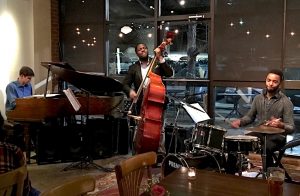
Your Jazz Audition: What are schools really looking for?
Dick Dunscomb, Columbia College Chicago’s jazz chair, urges students to do their research in advance. “Find out what the schools really want (before you go off to auditions).” See what you can find out so you can be as prepared as possible. Expect to be asked to improvise and sightread.
John Murphy, an ethnomusicologist and saxophonist and jazz chair at University of North Texas, says “Our professors listen for potential, as well as for a student’s current level of performance. Some things that indicate potential are:
- a sound on the instrument that reflects your experience of listening to the best artists of that instrument;
- a consistent time feel and articulation that goes well with the time feel;
- an understanding of basic jazz harmony and how to build solo lines that express the harmony.”
USC piano professor, Alan Pasqua, adds, “Auditions go by faster than you’d ever imagine. Faculty try to make them warm and friendly, but have to make critical decisions quickly, through prescreens and then interactions. So have your audition tunes prepared. The audition is not a time to show off. And if you’re a composer, bring in a piece of your own.”
For more on jazz auditions, see If You Want to Major in Jazz…


Austin
Very informative!
Stephanie
This article was very informative on planning for a career or education in jazz music. I found it interesting that like with most programs or goals, that one of the first steps was to choose a direction or have a goal. Having to take classes on how to teach jazz I would assume to be completely different than performance classes.
MajoringInMusic
We’re glad this was a useful article for you! Teaching requires pedagogy training, which is typically part of doctoral programs for teaching on the college level or, for K-12, music education programs. Those who teach also need to be highly proficient and active performers as well – they need to be good models for their students as well as stay fresh with the genre. They will also be better able to support their students who want to pursue jazz performance.
Nancy K
I’m right in the middle of this process with my son who will be a jazz performance major in the Fall. Several of his auditions were nothing at all like what the College had indicated in terms of song selection, band or no band, group or solo audition, etc.
So, travel thousands of miles, prepare for the audition as requested and then have it switched up.
It didn’t phase him too much, but as a parent I’m wondering if this was done on purpose to see how he would adapt, or through lack of planning, personnel or resources.
The lack of feedback from the Colleges where he either wasn’t accepted or didn’t even get to audition after submitting a prescreen video, was disheartening.
John Spencer
Great article, but there is even more. Idealistically, music is an art. Practically, it is also a business. Organizing and leading a successful band, for instance, may not require non-performance skills, but your chances of surviving and succeeding grow dramatically if you can manage, negotiate, plan, budget, market, sell, read and revise a contract, invest, save, teach, relate and make friends of people you may not like or respect but might need — among other things. Today, more than ever, a successful career in jazz (or any performing art) means going beyond music. Too often, the successful musician or ensemble is not the most artful at playing, but the most adept at these non-musical disciplines.